


Book Reviews

THE LIBRARY JOURNAL

As the personal assistant to John Lennon and Yoko Ono, Pang earned the respect and love of the couple for whom she worked.  This respect eventually turned into a complicated, though very clearly authentic.  romantic relationship between Pang and Lennon. The relationship-—which Pang claims was encouraged by Ono during Ono and Lennon’s temporary separation—is documented through several surprisingly candid photographs taken by the author
during her time with the former Beatle. Of note is the fact that Pang was able to capture both the mundane (Lennon sailing with his son Julian and the author on Long Island Sound) and the monumental (Lennon signing the legal papers that would bring The Beatles to its official end), yet treat each moment with the same amount of affection and admiration with thoughtful, detailed anecdotes throughout the book.  Through over 150 photographs. Pang captures a sense of both Lennon’s love of America and her own deep affection for Lennon. The collection ultimately works as a heartfelt portraitand rare glimpse into the world of one of the most influential musicians in pop culture history. Highly recommended.—
Sybil Kollappallil. Library Journal – February 15, 2008

—–

THE NEW YORK TIMES Art Section March 12, 2008

A Fond Look at Lennon’s ‘Lost Weekend’

Published: March 12, 2008

Correction Appended

If there’s one thing that May Pang has been fighting for the last 28 years, it’s the idea that John Lennon was depressed, isolated and out of control during the 18 months she lived with him, from the summer of 1973 to early 1975, when he reconciled with his second wife, Yoko Ono.


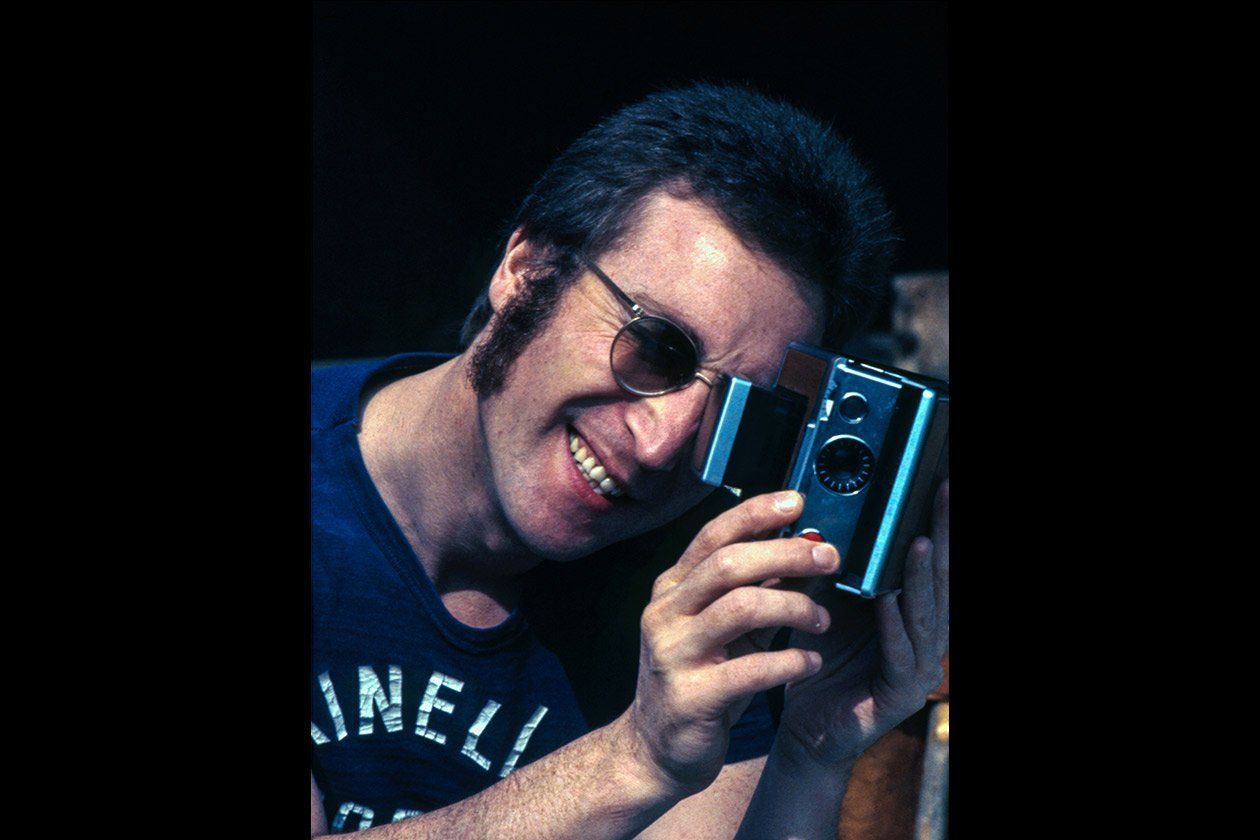
Photographs from “Instamatic Karma”

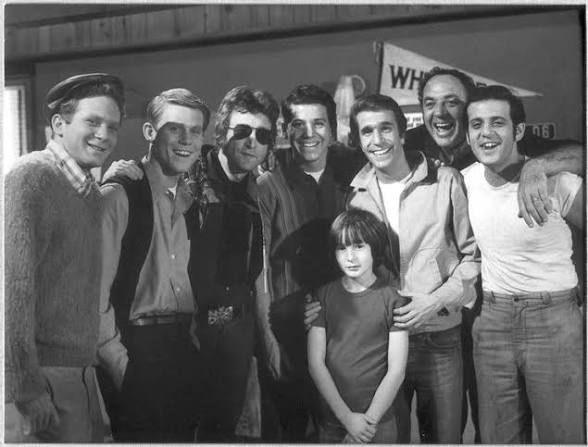
“Instamatic Karma” photographs from 1973-75 of May Pang and John and Julian Lennon, along with Harry Nilsson. 

Instamatic Karma

Lennon himself fostered that notion by referring to the time as his “Lost Weekend” in interviews he gave in 1980, when he released “Double Fantasy,” a joint album with Ms. Ono that was his return to music-making after five years’ silence. And lurid, oft-repeated tales of a drunken Lennon’s being evicted from the Troubadour, a nightclub in Los Angeles, seemed to support that image.

But to Ms. Pang, now 57, the “Lost Weekend” was a remarkably productive time, during which Lennon completed three albums — “Mind Games,” “Walls and Bridges” and “Rock ’n’ Roll” — produced songs for Ringo Starr and Harry Nilsson, and recorded with David Bowie, Elton John and Mick Jagger. And having already detailed these experiences (along with the Troubadour expulsions and other dark moments) in “Loving John,” her 1983 memoir, Ms. Pang has returned with the photographic evidence.

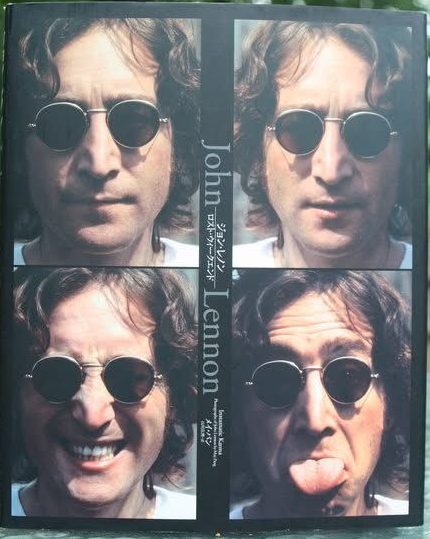
Her new book, “Instamatic Karma” (St. Martin’s Press), is a 140-page collection of casual photos that Ms. Pang took during her time with Lennon. Apart from a handful included in “Loving John” — cropped and in black and white, but mostly printed in full and rich color here — she has kept them in a shoe box in her closet, occasionally pulling them out to show friends.

“I began to think about publishing them just in the last couple of years,” Ms. Pang said on Monday at her publisher’s office in the Flatiron Building. “A friend of mine kept saying, ‘You tell all these stories about John, and when you do, you say, “Wait a minute, I have a photo to go along with that!” How come we never see these photos in a book?’ So, I thought maybe it’s time to put them out. It would let people see John in that world, through my eyes. And it would get rid of that whole ‘Lost Weekend’ thing, where everyone says he was always down and looked terrible. I don’t think these photos appear that way.”

They don’t: in the pages of “Instamatic Karma” — the title is a play on Lennon’s song “Instant Karma” — Lennon looks relaxed and happy, and is seen spending time with his first son, Julian, as well as with some famous friends, among them Paul McCartney, Ringo Starr, Nilsson and Keith Moon. He is shown working in the recording studio, swimming in Long Island Sound, clowning around in Central Park and visiting Disney World.

“They are personal and unique and very touching,” said Cynthia Lennon, Lennon’s first wife, who flew to New York from her home in Mallorca, Spain, to be the host of Ms. Pang’s publication party at the Cutting Room on Tuesday. Ms. Lennon got to know Ms. Pang when she escorted her son, Julian, on two of his four trips to visit his father while he was living with Ms. Pang.

“It’s lovely for me to look back, especially with Julian in these photographs,” she said. “But I’m here just because May is a good friend of mine and has been since we met.”

Ms. Pang arranged her book by subject instead of chronologically, with four chapters labeled “At Home,” “At Play,” “At Work” and “Away.” To her regret, she did miss a few famous moments. The March 28, 1974, Los Angeles jam session that included Lennon, Nilsson, Mr. McCartney and Stevie Wonder, for example, was not documented.

But Ms. Pang did capture one momentous event: Lennon’s signing the agreement that dissolved the Beatles’ partnership on Dec. 29, 1974.

After four years’ negotiation, the Beatles had agreed — or appeared to have — on the terms governing their formal split, and a meeting had been arranged at the Plaza Hotel in Manhattan on Dec. 19. George Harrison was performing at Madison Square Garden that night; Mr. McCartney had flown in from London; and Mr. Starr, having signed the document earlier, was on the telephone.

At the last minute, Lennon objected to a clause that he felt would create tax problems for him (as the only Beatle living in the United States), and decided not to attend. Harrison, furious, canceled plans for Lennon to join him onstage at Madison Square Garden, but Mr. McCartney turned up at the East 52nd Street apartment that Lennon and Ms. Pang shared to discuss the sticking point.

Ten days later, when Lennon, Julian and Ms. Pang were at Disney World, a lawyer bearing the revised contract turned up, and Lennon asked Ms. Pang to take out her camera. As Ms. Pang describes the scene in “Instamatic Karma,” Lennon had a last-minute telephone conference with his own lawyer

“When John hung up the phone,” she writes, “he looked wistfully out the window. I could almost see him replaying the entire Beatles experience.” Ms. Pang then photographed him signing just beneath the clearly legible signatures of Paul McCartney, George Harrison and Richard Starkey (Mr. Starr’s real name), the shutter clicking between the “h” and “n” of his first name.

Given that Lennon had been particularly militant about leaving the Beatles in 1969, it might seem odd to learn that he did so wistfully. Not to Ms. Pang.

“Everybody changes,” she said. “With John things changed on a daily basis. It’s a question of time. Five years earlier was not the same situation. In 1974 he had just seen everyone. The friendship was still there. They were brothers. There was no animosity. And even though they all felt they had to break up to get to the next level of their musical careers, John had started this band that changed the world. It changed pop culture. It changed how we live and how we dress. And he knew that. So when he sat down to sign, he knew that this was it. His was the last signature. As he had started the group, he was the one to end it.”

This article has been revised to reflect the following correction:

Correction: March 14, 2008
An article in The Arts on Wednesday about photographs of John Lennon taken by May Pang, who lived with him for 18 months during the mid-1970s, referred incorrectly to production work Mr. Lennon did for Ringo Starr in that period. He is credited with having supervised the recording of the title track of Mr. Starr’s album “Goodnight Vienna,” a song Mr. Lennon wrote; he did not produce an album for Mr. Starr.

—–
LOS ANGELES TIMES BOOK REVIEW
‘Instamatic Karma’ by May Pang

John Lennon’s lover documents the former Beatle’s life off the celebrity merry-go-round.
By Eric Himmelsbach, Special to The Times|March 20, 2008

LONG before paparazzi became telephoto lens-wielding stalkers, John Lennon’s life played out in front of the cameras. From his time with the Beatles to “bed-ins” and talking peace and revolution on “The Dick Cavett Show,” the British musician did much of his living in the eye of a cultural hurricane. Arguably, he was the world’s first reality TV star.

Generation-shaping music, countless hours of concert and candid film footage — and carefully orchestrated media events — helped elevate Lennon beyond the realm of pop phenomenon into a sort of Jesus of hip. His 1980 murder only enhanced his status as a “spokesman for a generation,” a legacy lovingly — and profitably — tended by his widow, Yoko Ono.

With the passage of time, Lennon’s life has taken on an increasingly beatific aura. But it’s easy to forget that the myth is not the man. Of course, Lennon was complicit in the myth-making, so the line between what was real and the “reality” of what we see has been consciously blurred. Was it possible for John Lennon to be himself without being “John Lennon”?

The answer is yes, at least for a brief period. The new book “Instamatic Karma: Photographs of John Lennon” captures 18 months of his life — coinciding with a 1973 separation from Ono — when he was just another footloose rock star having a good time. This candid collection of photos of Lennon, shot by his assistant-turned-lover May Pang, isn’t about a statue in Central Park, inspirational songs or an agitprop superhero. Pang documents a joyously disarming visual travelogue of a guy stepping off the merry-go-round and embracing life. The guy just happens to be John Lennon.

Pang isn’t a professional. Her photos are intimate, sometimes blurry snapshots of a life-in-progress, one unfettered by the forces that had defined him: the Beatles and Ono. His relationship with her, in particular, was a love story documented through a series of performance art installations.

But by the summer of 1973, their marriage on the rocks, Ono chose Pang, who was working for them as a personal assistant and production coordinator, to be her husband’s lover.

Pang already has documented her relationship with Lennon in the 1983 memoir “Loving John,” reissued in 1992 as “John Lennon: The Lost Weekend.” But this casual photographic record of their time together speaks volumes. It was a period in which Lennon drank, took drugs and hung with pals. But he also produced an album for Harry Nilsson (“Pussy Cats” in 1974) and recorded the most commercially successful music of his solo career, including “Whatever Gets You Through the Night,” the 1974 song that was his only No. 1 U.S. solo hit while he was alive. The late musician’s friend Larry Kane writes in the introduction to “Instamatic Karma” that Lennon told him this period was among his happiest.

Pang and Lennon spent their time in New York and, more notoriously, in Los Angeles, which in the early 1970s had become a decadent playpen for self-exiled English rock stars, including Ringo Starr and Who drummer Keith Moon. There was a collective early mid-life crisis going on, and the expat Brits wallowed in it together, a gang of overgrown kids with too much money and too much time on their hands.

The couple rented a beach house owned by Rat Pack actor Peter Lawford that a dozen years earlier was said to have been a love shack for Marilyn Monroe and the Kennedy brothers. It became a clubhouse for out-of-their-head musicians Moon, Starr, Nilsson and others, all appropriately pictured in “Instamatic Karma.”

The revolutionary man of peace became a party animal, wearing a sanitary napkin on his forehead at the Troubadour nightclub and getting tossed from the same club for brandy Alexander-fueled heckling. Along the way, Lennon visited Palm Springs (tagging along with Nilsson on a doctor’s appointment); Las Vegas, where he and Pang caught a Fats Domino show at Caesars Palace; Disneyland and Disney World with Lennon’s son Julian by his first wife, Cynthia. The photos of father and son pack the most wallop, capturing the anxiousness and affection of their first visits together in several years.

Although the text is thin, Pang recounts a few eyebrow-raising tidbits. She says Lennon asked her to attend a 1974 Beatles fan convention to buy up all copies of his 1968 album with Ono, “Two Virgins.” According to Pang, Lennon had become embarrassed by the album’s infamous cover, which features a full frontal nude portrait of him and Ono.

Pang also reveals Lennon’s nostalgia for the Beatles. A vocal advocate of the band’s 1970 breakup, he had softened his stance and, sans Ono, rekindled a friendship with Paul McCartney (Pang captures the songwriting duo chatting in 1974), and even hung out with his former bandmate in L.A., where they participated in an inebriated jam session (with Nilsson and Stevie Wonder) that has been bootlegged as “A Toot and a Snore.”

Lennon had big plans for 1975, Pang writes. He was about to make an offer on a house in the Hamptons to share with her; he also wanted to surprise McCartney and his new band, Wings, in New Orleans, where they were recording “Venus and Mars.”

But the day before Lennon’s scheduled flight in early 1975, he visited Ono at his old Manhattan apartment in the Dakota and simply never left. He dropped out of sight and retreated into the man of myth: investing in Holstein cows, baking bread as house-husband and dad to infant son Sean and taking a five-year sabbatical from recording.

In “Instamatic Karma,” Pang, who experienced a side of Lennon few others did, allows us a rare glimpse of the man beneath the impenetrable layers of legend.

Eric Himmelsbach is a writer and television producer.

—–
THE NEW YORK DAILY NEWS Saturday, April 5th 2008, 4:00 AM

JOHN, YOKO AND MAY, TOO

BY DAVID HINCKLEY

There has at times been a sharp, nasty edge to discussions about John Lennon‘s relationships with his wife Yoko Ono and his 18-month girlfriend, May Pang, in the 1970s.

In that context, 27 years after his death, these two new photo books might feel like a continuation of that talk, as if the two sides are presenting their cases.

But for the reader, at least, time has had a curiously softening effect. The beautifully framed and composed shots in “John and Yoko: A New York Love Story” (Insight Editions, $45) by Allan Tannenbaum feel only like a different part of his life from the informal snapshots that Pang saved in a shoebox for 30 years.

Some of the Yoko book shots have a studied, almost formal feel, particularly ones from a session where John and Yoko disrobe to be photographed naked in bed.

Through much of the book Yoko also seems less openly expressive than John – an impassive look that makes her particularly luminous when she does smile.

The pictures in “Instamatic Karma: Photographs of John Lennon” (St. Martin’s, $29.95) by May Pang are less artistic, but for many more interesting. They show John playing guitar with Julian, then 10, or horsing around with Harry Nilsson. A picture of John with the infamous Morris Levy is a for-sure keeper.

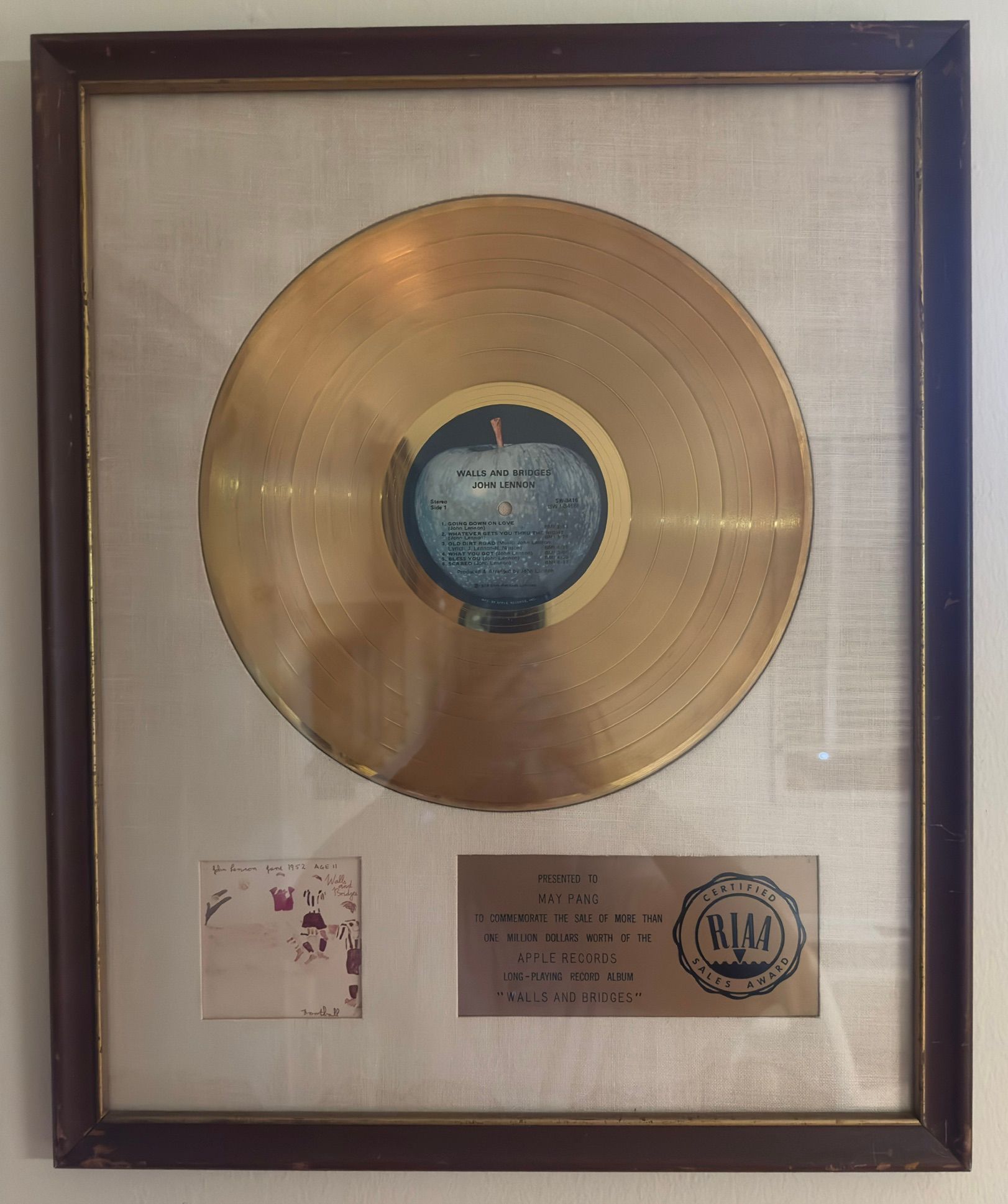
John looks generally relaxed, sometimes more so than in later pictures, and that’s consistent with the several short recollections Pang offers on events from those years: recording “Walls and Bridges” or the oldies album, vacationing with Mick Jagger, wrapping up the official dissolution of the Beatles.

In the end, the photos reaffirm that the only person who could answer the questions – Where does he look happier? Was his time with Pang really a “lost weekend”? – is gone.

However Lennon might have wanted to spend the last decade of his life, this is how he did it, and somewhere he’s probably getting a good larf out of the idea that anyone would still be asking why.

—–

Share and Enjoy:
  • Print
  • Digg
  • Sphinn
  • del.icio.us
  • Facebook
  • Mixx
  • Google Bookmarks

About the Author